

German cockroach: Complete Control Guide
Finding a small brown cockroach in your kitchen can be more than an unpleasant surprise. It may be an early warning that insects are breeding behind your refrigerator, inside kitchen cabinets, beneath appliances, or around plumbing. One species deserves particular attention: the German cockroach (Blattella germanica).
Unlike cockroaches that occasionally enter buildings from outdoors, this indoor pest thrives in human environments and can multiply quickly when food, water, warmth, and shelter are available. Its small size allows it to hide in narrow spaces, while its reproductive biology makes established populations difficult to eliminate.
This guide explains what a German cockroach looks like, how to identify a German cockroach nymph or baby German cockroach, what its eggs look like, where infestations develop, and why these insects are so persistent. You’ll also learn how to inspect your home, recognize warning signs, use an integrated pest management (IPM) strategy, choose appropriate treatment methods, and prevent the insects from returning.
What Is a German Cockroach?
A German cockroach is a small, light-brown household pest scientifically known as Blattella germanica. It belongs to the order Blattodea and is strongly associated with indoor human environments, particularly kitchens, bathrooms, restaurants, and multi-unit residential buildings.
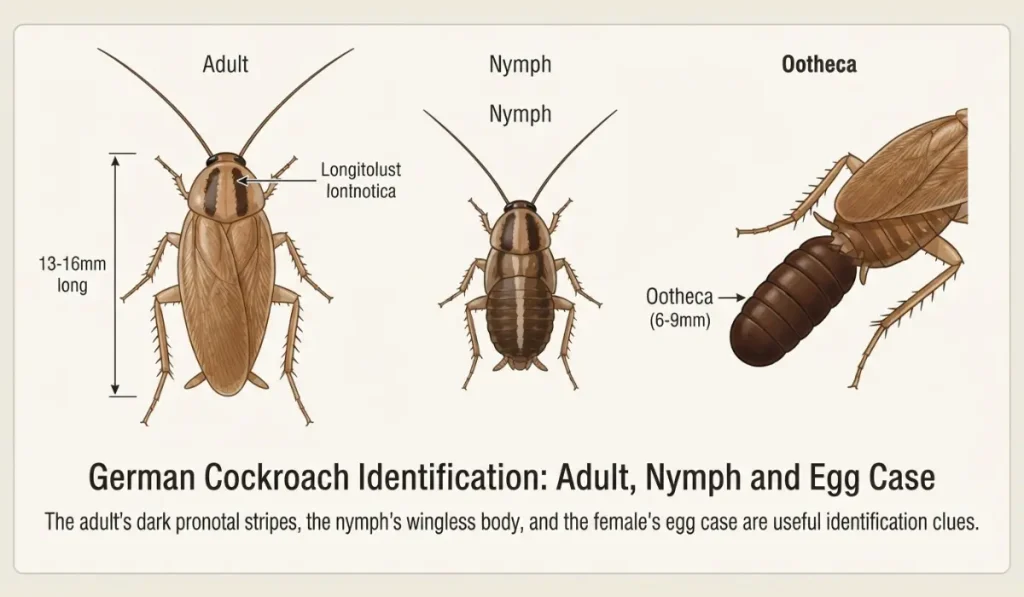
Adults measure approximately ½ to ⅝ inch (13–16 mm) long. Their most recognizable feature is a pair of dark, parallel stripes on the shield-like section immediately behind the head.
Although the species has the word “German” in its common name, its geographical origin is not definitively established by that name. The insect is now distributed widely around the world, largely through human transport and commercial activity.
Unlike many outdoor cockroach species, it generally does not depend on gardens, drains, or outdoor vegetation to establish a population. It can live and reproduce inside buildings where conditions remain suitable.
Scientific classification:
| Classification | Name |
|---|---|
| Common name | German cockroach |
| Scientific name | Blattella germanica |
| Order | Blattodea |
| Family | Ectobiidae |
| Adult size | 13–16 mm |
| Typical color | Tan to light brown |
| Distinctive marking | Two dark parallel pronotal stripes |
| Development | Egg, nymph, adult |
| Preferred environment | Warm indoor spaces with food, water, and shelter |
The species is especially troublesome because it combines rapid reproduction, small body size, indoor adaptability, and the ability to hide close to everyday food and water sources.
For a detailed scientific explanation, see NC State Extension’s biology and behavior guide.
What Does a German Cockroach Look Like?
An adult has a flattened, oval body, six legs, long antennae, and a light-brown or tan appearance. Two dark parallel stripes on the pronotum, the shield-like area behind its head, are the most reliable visual identification features.
These markings help distinguish it from several other household cockroach species.
Adult identification
Look for the following characteristics:
- Size: Approximately 13–16 mm long.
- Color: Light brown, tan, or brownish.
- Pronotum: Two dark, nearly parallel stripes behind the head.
- Body: Oval, flattened, and relatively narrow.
- Antennae: Long, thin, and constantly moving.
- Wings: Adults have wings that cover much of the abdomen.
- Movement: Fast-moving and likely to escape into narrow gaps when disturbed.
Both sexes have wings, although they are not known for sustained flight in ordinary household conditions.
Male versus female German cockroaches
Male and female adults have slightly different body shapes.
| Feature | Male | Female |
|---|---|---|
| Body shape | Narrower and more slender | Broader and thicker |
| Abdomen | More tapered at the rear | More rounded at the rear |
| General appearance | Often lighter | Often darker |
| Egg case | Does not carry one | Carries an ootheca during development |
A female carrying an egg case is particularly important to recognize because it indicates reproductive activity.
How to distinguish it from other cockroaches
Not every small brown cockroach is the same species. Correct identification matters because different species have different habitats and control requirements.
| Species | Approximate adult size | Appearance | Common habitat |
|---|---|---|---|
| German cockroach | 13–16 mm | Tan with two dark stripes behind head | Kitchens, bathrooms, indoor buildings |
| American cockroach | 30–50 mm | Reddish-brown with a pale marking behind head | Drains, basements, utility areas |
| Oriental cockroach | 20–27 mm | Dark brown to black | Damp basements, drains, outdoor areas |
| Brown-banded cockroach | 10–14 mm | Brown with pale transverse bands | Furniture, bedrooms, warmer rooms |
| Asian cockroach | 13–16 mm | Similar to German cockroach | Outdoor vegetation and illuminated areas |
The Asian cockroach is particularly easy to confuse with its German relative. Identification may require examining behavior, habitat, and other physical features rather than relying on color alone.
What Does a Baby German Cockroach Look Like?
A baby German cockroach is called a nymph. It looks like a smaller, darker version of the adult but does not have fully developed wings. Young nymphs are usually dark brown to nearly black, sometimes with a pale stripe or marking running down the center of the back.
Newly hatched nymphs are approximately 3 mm long. They gradually grow larger through a series of molts.
German cockroach nymph identification
Look for these features:
- Very small, oval body.
- Dark brown, grayish-brown, or nearly black color.
- No developed wings.
- Six legs and long antennae.
- A pale marking or stripe on the back in early developmental stages.
- Fast movement toward cracks, cabinet joints, or other sheltered spaces.
Nymphs often remain close to their hiding places because they are more vulnerable than adults.
Baby German cockroach versus bed bug
People frequently confuse young cockroaches with bed bugs, particularly when they find tiny insects around bedrooms or furniture.
| Identification feature | German cockroach nymph | Bed bug nymph |
|---|---|---|
| Body shape | More elongated and oval | Broad and flattened |
| Antennae | Long and noticeable | Shorter |
| Movement | Usually runs quickly | Generally moves more slowly |
| Typical hiding places | Kitchens, appliances, cabinets | Mattress seams, bed frames, furniture |
| Food source | Crumbs, grease, organic material | Blood meals |
| Wings | Absent in nymphs | Absent throughout development |
A small insect found near a mattress is not automatically a bed bug. Examine its body shape and look for additional evidence before deciding which pest is present.
Why finding baby roaches matters
Finding one adult may indicate that a cockroach has entered your property. Finding multiple nymphs, particularly very small ones, suggests that reproduction may be occurring nearby.
Look closely around the area where the nymphs were found. The likely hiding place may be behind an appliance, beneath a sink, inside a cabinet hinge, or around a warm electrical component.
What Do German Cockroach Eggs Look Like?
German cockroach eggs develop inside a protective capsule called an ootheca. The capsule is usually tan or light brown, purse-shaped, and approximately 8 mm long.
Rather than laying individual eggs in exposed locations, the female carries the developing egg case protruding from the end of her abdomen until shortly before hatching.
A typical ootheca contains approximately 30–40 eggs.
How to recognize an ootheca
An egg case usually has these characteristics:
- Small, elongated capsule.
- Tan, brown, or light-brown color.
- Slightly ridged or segmented appearance.
- Approximately 8 mm long.
- Usually associated with a female cockroach.
It may look like a tiny brown capsule rather than a collection of loose eggs.
Where are German cockroach egg cases found?
Look in sheltered locations near food and water, including:
- Behind refrigerators.
- Beneath kitchen sinks.
- Inside cabinet corners.
- Behind dishwashers.
- Around stove components.
- Inside narrow cracks and crevices.
A female typically keeps the ootheca attached until close to hatching. This behavior provides protection to the developing eggs and helps explain why reproductive activity can be difficult to detect.
An important distinction: an empty or detached egg case does not necessarily mean dozens of live nymphs will emerge. Its condition and developmental stage matter.
For more detail, Rutgers Cooperative Extension’s German cockroach fact sheet explains the egg case, nymphal development, and adult identification.
German Cockroach Life Cycle and Reproduction
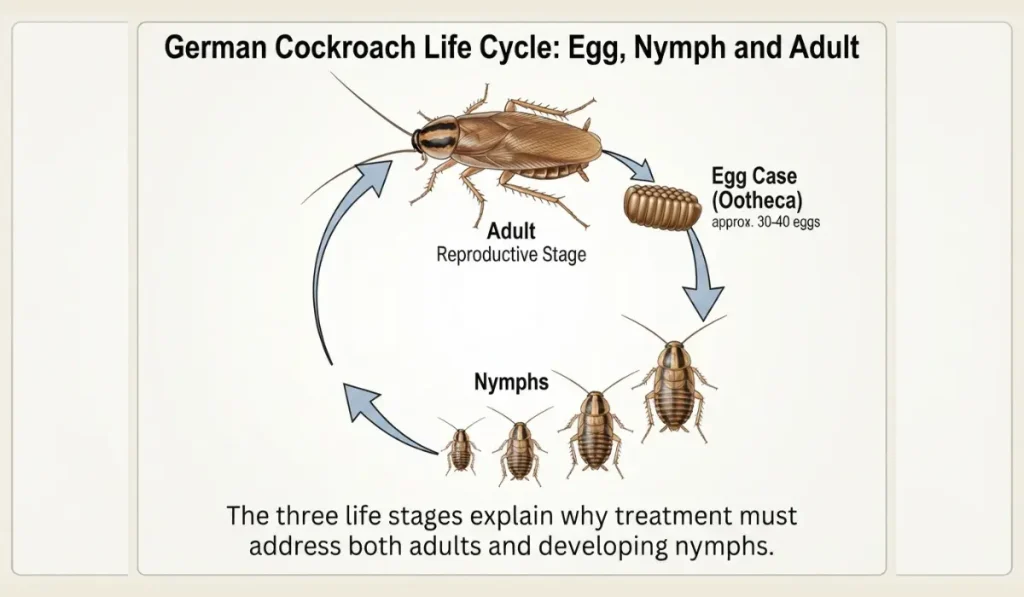
German cockroaches develop through three stages: egg, nymph, and adult. This is called incomplete metamorphosis because they do not have a pupal stage.
The complete process can take approximately 70–100 days under favorable conditions, although temperature, food availability, humidity, and other environmental factors influence development.
Stage 1: Egg case
The female produces an ootheca containing approximately 30–40 eggs.
She carries it until shortly before the young hatch. The eggs develop inside the protective capsule, which is approximately 8 mm long.
Stage 2: Nymph
After hatching, the young cockroaches emerge as wingless nymphs.
They gradually increase in size by shedding their external skeletons. This process is called molting.
German cockroach nymphs typically pass through five or six developmental stages, known as instars, before becoming adults.
Stage 3: Adult
Once the final molt is complete, the cockroach becomes an adult.
Adults develop wings and the characteristic two dark stripes behind the head. Females become reproductively active and can produce additional egg cases.
A female may produce several oothecae during her lifetime, giving a small initial population considerable reproductive potential.
Where Do German Cockroaches Hide?
Cockroaches prefer warm, dark, relatively humid locations close to food and water. They are primarily active at night, spending much of the day inside narrow gaps and sheltered spaces.
Their preferred hiding places are not necessarily dirty or neglected areas. Even well-maintained homes can provide suitable conditions behind appliances, inside cabinets, and around plumbing.
Common kitchen hiding places
Check these areas first:
- Behind and beneath refrigerators.
- Around refrigerator motors and compressor compartments.
- Beneath dishwashers.
- Inside kitchen cabinets.
- Under sinks and around plumbing connections.
- Behind ovens and stoves.
- Inside drawer runners and cabinet joints.
- Around microwave and coffee-machine housings.
Bathroom and utility-room hiding places
Bathrooms and utility spaces may provide the moisture these insects need.
Inspect:
- Around leaking pipes.
- Beneath bathroom sinks.
- Behind washing machines.
- Around water heaters.
- Inside utility cabinets.
- Near floor drains and plumbing penetrations.
Can cockroaches live inside electronics?
Yes. Warm appliances and electronic equipment may provide sheltered spaces, especially when ventilation openings offer access to internal components.
Coffee machines, microwaves, televisions, computers, and other warm devices may become harborages when nearby food and moisture are available.
Do not spray insecticides directly into electronic equipment. Use appropriate inspection and treatment methods, or seek professional assistance.
What Are the Signs of a German Cockroach Infestation?
Common signs include live or dead cockroaches, small dark droppings, shed skins, egg cases, and repeated sightings around kitchens and bathrooms.
The strongest evidence is a combination of signs, especially when different life stages are present.
1. Live cockroaches
Seeing insects running away when you turn on a light is a common warning sign.
Repeated sightings in the same location suggest an established hiding place nearby.
2. Small dark droppings
Cockroach droppings may appear as tiny dark specks, resembling ground pepper or coffee grounds.
Look for them around:
- Cabinet corners.
- Drawer joints.
- Refrigerator edges.
- Under sinks.
- Appliance compartments.
3. Shed skins
Nymphs shed their external skeletons as they grow.
These discarded skins may accumulate near hiding places and provide evidence of developmental activity.
4. Egg cases
An ootheca is a particularly useful warning sign because it indicates reproductive activity.
Look for it around sheltered spaces near food and water.
5. Unusual odor
A large or established population may produce a persistent, unpleasant, musty odor.
Odor alone is not a reliable identification method, but it can strengthen other evidence.
6. Daytime sightings
Although these insects are primarily nocturnal, they may appear during daylight when their hiding places become overcrowded or disturbed.
Daytime activity deserves attention, particularly when accompanied by other infestation signs.
7. Repeated sightings of nymphs
Finding multiple baby cockroaches in the same area is a strong reason to investigate for a nearby breeding population.
How to determine whether the problem is established
Use this practical assessment:
| Observation | What it may indicate |
|---|---|
| One adult seen once | Possible introduction; inspect the area |
| Repeated adult sightings | Possible established population |
| Multiple nymphs | Likely nearby reproduction |
| Egg cases and droppings | Evidence of reproductive activity |
| Adults and nymphs together | Possible overlapping generations |
| Cockroaches in multiple rooms | Wider distribution requiring investigation |
Do not estimate the population from one sighting alone. Use sticky monitors and repeated inspections to determine where activity is concentrated.
Why Am I Getting German Cockroaches?
They are usually introduced through human activity rather than entering from outdoor breeding populations. They can travel inside grocery bags, cardboard packaging, used appliances, furniture, delivery containers, and personal belongings.
Once inside, they can establish themselves wherever suitable food, water, warmth, and hiding places are available.
1. Grocery bags and food packaging
Cardboard boxes and reusable shopping bags can provide hiding places.
Inspect packaging, especially if it has been stored in warehouses, kitchens, or other areas where cockroaches may be present.
2. Secondhand appliances and furniture
Used refrigerators, microwaves, coffee machines, and other household equipment may contain insects or egg cases.
Inspect these items before bringing them inside.
3. Neighboring apartments
Cockroaches can move between connected apartments through wall gaps, plumbing penetrations, utility openings, and other structural routes.
Treating only one apartment may not solve the problem if nearby units remain infested.
4. Food and moisture availability
Crumbs, cooking grease, pet food, leaking pipes, and standing water help support a population.
Even small amounts of food and moisture can make an area suitable.
5. Clutter and cardboard storage
Stacks of paper, cardboard boxes, and unused packaging create additional hiding places.
Reducing clutter makes inspections easier and removes potential harborages.
How to Get Rid of German Cockroaches: A Step-by-Step Treatment Plan
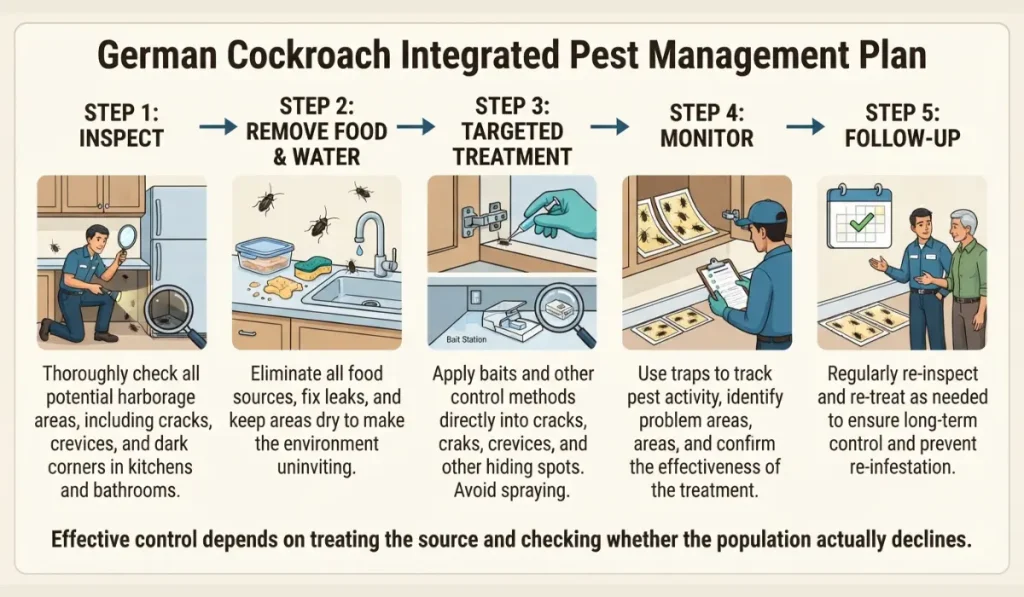
The most reliable approach combines inspection, sanitation, targeted baiting, monitoring, and follow-up. Spraying visible insects alone rarely addresses the entire population because many cockroaches remain hidden inside cracks, appliances, and cabinets.
An integrated pest management (IPM) program focuses on finding the source and reducing the conditions that allow the population to survive.
Step 1: Inspect the property
Start by identifying where cockroaches are most active.
Use a flashlight to examine:
- Kitchen cabinets.
- Refrigerator and dishwasher areas.
- Under-sink plumbing.
- Stove compartments.
- Bathroom cabinets.
- Utility spaces.
- Cracks and narrow gaps.
Look for live insects, droppings, shed skins, and egg cases.
Do not assume the first room where you see a cockroach is the only affected area.
Step 2: Use sticky traps to locate activity
Sticky traps, also called glue boards, are valuable monitoring tools.
Place them along wall edges, inside cabinets, behind appliances, and near suspected hiding places.
Number each trap and record how many cockroaches it catches.
A useful inspection record includes:
| Trap location | Initial catch | Follow-up catch | Interpretation |
|---|---|---|---|
| Under kitchen sink | Record actual count | Record actual count | Check plumbing and cabinet gaps |
| Behind refrigerator | Record actual count | Record actual count | Inspect warm appliance spaces |
| Near dishwasher | Record actual count | Record actual count | Check moisture and food debris |
| Bathroom cabinet | Record actual count | Record actual count | Check water sources |
The numbers should come from actual monitoring rather than estimates.
Step 3: Remove food and water sources
Sanitation is essential because cockroaches compete with bait products for food.
Complete these tasks:
- Clean food spills and grease.
- Wash dishes rather than leaving them overnight.
- Store food in tightly sealed containers.
- Keep garbage in covered bins.
- Remove pet food when it is not being used.
- Vacuum crumbs beneath appliances.
- Clean inside cabinet corners.
- Repair leaking taps and pipes.
- Dry wet surfaces where practical.
- Remove unnecessary cardboard and paper clutter.
Cleaning alone may not eliminate an established population, but it makes targeted control more effective.
Step 4: Use appropriately labeled cockroach baits
Gel baits and enclosed bait stations can be effective when positioned near cockroach harborages.
They contain an attractant food base combined with an insecticide.
The active ingredient varies by product. Examples used in cockroach bait formulations include indoxacarb, fipronil, abamectin, and hydramethylnon.
Do not assume that every product is suitable for every location or country. Registration, permitted uses, and availability differ between the United States, Canada, the United Kingdom, and Australia.
Follow the product label exactly.
Important principles include:
- Place bait close to areas of confirmed activity.
- Keep bait away from children and pets.
- Do not contaminate bait with cleaning products or insecticide sprays.
- Avoid placing bait on surfaces exposed to food preparation.
- Replace or refresh bait according to the label.
- Reassess activity using sticky monitors.
Baits do not usually produce instant results. UC IPM notes that reductions may take seven days or longer, depending on the situation and treatment.
Step 5: Consider insect growth regulators
Insect growth regulators (IGRs) interfere with normal insect development or reproduction.
Products containing ingredients such as hydroprene or pyriproxyfen may be used as part of a professional or appropriately labeled treatment program.
They are not instant adult-killing products. Their purpose is to disrupt population development and complement other control methods.
Step 6: Use dust products only where appropriate
Certain insecticidal dusts, including boric acid formulations, may be used in suitable dry, undisturbed areas.
They must be applied strictly according to the product label.
Avoid leaving loose pesticide dust on exposed floors, counters, or areas where children and pets may encounter it.
Professional assistance is sensible when treatment requires access to wall voids, appliance interiors, or other difficult spaces.
Step 7: Monitor and repeat as necessary
After treatment begins, inspect sticky traps regularly.
Compare the number of insects caught at each location with the initial counts.
A declining catch is encouraging, but one empty trap does not prove the infestation has disappeared.
Continue monitoring for adults, nymphs, droppings, and egg cases. Reassess bait placement and other conditions if activity remains high.
Why German Cockroaches Are Difficult to Eliminate
They can be difficult to control because of their reproductive capacity, concealed harborages, rapid development, and ability to survive in indoor environments.
However, the problem is not simply that they reproduce quickly. Their behavior can also make poorly planned treatment ineffective.
Insecticide resistance
Some populations have developed resistance to particular insecticide active ingredients.
Repeated use of the same ineffective product may fail to control the population.
Bait aversion is another concern. Some cockroach populations avoid particular bait formulations because they find the food base unattractive.
The practical lesson is to avoid assuming that one bait or spray will work everywhere.
A professional may need to assess the treatment history, identify the product’s active ingredient, and select an appropriate alternative.
Hidden breeding locations
A large proportion of the population may remain inside narrow gaps and sheltered spaces.
Spraying exposed surfaces may kill a few visible insects without reaching the population behind appliances or inside cabinets.
Overlapping generations
Adults, nymphs, and newly hatched insects can exist together.
A treatment that reduces visible adults may leave developing insects behind.
Reintroduction from neighboring units
In apartments and connected buildings, nearby infestations can undermine treatment.
Effective control may require cooperation between tenants, property managers, landlords, and pest-control professionals.
Why Bug Bombs and Random Spraying Often Fail
Total-release foggers and indiscriminate aerosol sprays are not reliable stand-alone solutions for German cockroach infestations.
The spray may not reach the narrow spaces where cockroaches hide. Some products can also repel or disperse insects, while misuse creates unnecessary pesticide exposure.
The US Environmental Protection Agency warns that total-release foggers can cause fires, explosions, and illness if used improperly.
The CDC also advises people with asthma to avoid sprays and foggers because they can trigger asthma symptoms.
A more targeted approach uses inspection, sanitation, monitoring, and appropriately labeled bait products.
Never combine pesticides or use a product in a way that is not permitted by its label.
German Cockroach Prevention: How to Stop Them Returning
Preventing a new infestation requires reducing food, water, hiding places, and opportunities for introduction.
Even after successful treatment, continue basic prevention because cockroaches can be transported into a previously pest-free property.
Kitchen prevention
- Store dry food in sealed containers.
- Wipe counters after cooking.
- Clean grease around cooking appliances.
- Empty kitchen waste regularly.
- Vacuum under the refrigerator.
- Keep pet food covered when not in use.
- Avoid leaving dirty dishes overnight.
Bathroom and plumbing prevention
- Repair leaking taps.
- Check under sinks regularly.
- Keep cupboards dry.
- Inspect pipe penetrations and wall gaps.
- Improve ventilation where condensation is a problem.
Storage and delivery prevention
- Inspect secondhand furniture before bringing it indoors.
- Check used appliances carefully.
- Avoid storing unnecessary cardboard in kitchens.
- Inspect grocery bags and delivery packaging.
- Keep storage areas organized and easy to inspect.
Apartment building prevention
If you live in a multi-unit building:
- Report sightings to the property manager promptly.
- Keep records of where and when insects are seen.
- Ask whether neighboring units require inspection.
- Request coordinated treatment when activity is widespread.
- Seal suitable gaps around plumbing and utility penetrations.
- Continue monitoring after treatment.
Treating one unit without investigating connected spaces may only provide temporary relief.
German Cockroach vs. American Cockroach: Important Differences
The German and American cockroaches are two different species with different sizes, markings, and typical habitats.
The American cockroach is substantially larger and reddish-brown, while the German species is smaller and tan with two dark stripes behind the head.
| Feature | German cockroach | American cockroach |
|---|---|---|
| Scientific name | Blattella germanica | Periplaneta americana |
| Adult size | 13–16 mm | Approximately 30–50 mm |
| Color | Tan to light brown | Reddish-brown |
| Markings | Two dark parallel pronotal stripes | Pale marking on pronotum |
| Typical habitat | Indoor kitchens and bathrooms | Drains, basements, sewers and utility areas |
| Reproduction | Female carries egg case until near hatching | Female deposits egg case in a sheltered location |
| Common concern | Rapid indoor population growth | Large insects entering from surrounding environments |
Correct identification matters because treatment should target the species’ actual habitat.
A large cockroach found near a basement drain may require a different inspection strategy from a small, dark-striped insect repeatedly appearing inside kitchen cabinets.
German Cockroach Control in Apartments and Rental Properties
Apartment infestations can be particularly challenging because cockroaches may move between connected units.
A tenant can maintain excellent hygiene and still experience recurring activity if a neighboring apartment, shared utility area, or structural void remains infested.
What tenants should do
- Photograph insects where practical.
- Record dates and locations of sightings.
- Keep food and waste properly stored.
- Report the problem to the landlord or property manager.
- Request a professional inspection.
- Keep records of treatment visits and monitoring results.
What landlords and property managers should do
- Arrange appropriate inspections.
- Identify affected units and shared spaces.
- Coordinate treatment where necessary.
- Address plumbing leaks and structural gaps.
- Provide tenants with clear preparation instructions.
- Schedule follow-up monitoring.
Responsibility for pest control and repair obligations varies by jurisdiction and tenancy agreement. Check the applicable local housing rules rather than assuming the same requirements apply in every country.
7 Common German Cockroach Control Mistakes
Even when people recognize the insect correctly, several mistakes can undermine treatment.
Frequently Asked Questions
Conclusion
These cockroaches are difficult household pests, but understanding their appearance, behavior, and reproductive cycle makes control more manageable.
The most useful identification clues are the adult’s tan body, two dark parallel stripes behind the head, and the smaller, darker, wingless appearance of the nymph. The female’s egg case is another important sign of reproductive activity.
If you suspect an infestation, inspect warm and humid areas near food and water, use sticky traps to identify activity, remove food and moisture sources, and consider appropriately labeled targeted bait treatments. Avoid relying on random spraying or foggers as a complete solution.
Most importantly, monitor the results. A successful treatment should produce a sustained reduction in activity, not simply a temporary disappearance of visible insects.
For persistent infestations, especially in apartments or multi-unit buildings, professional inspection and coordinated integrated pest management are often the most effective route to lasting control.